Painting
My Favorite Watercolor Supplies for Beginners
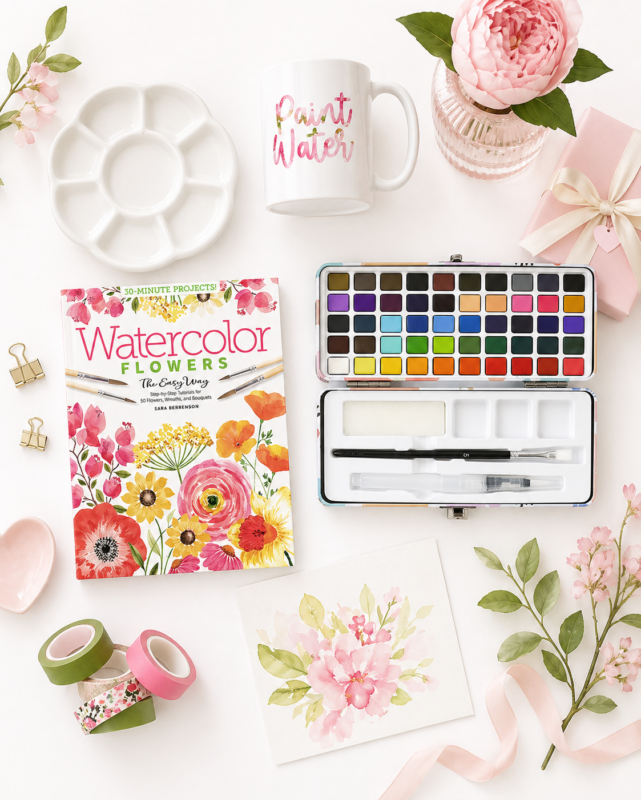
If you’re new to watercolor painting, or finding your way back to it after some time, the right materials don’t just support your work, they shape your experience of it. Whether you’re joining one of our online classes, or simply painting on your own at home, this guide will help you begin with confidence.
For our online classes, you’ll be gathering your own supplies (unlike our in-person workshops, where everything is provided), so this list is designed to keep things simple, approachable, and thoughtfully aligned with exactly what you’ll need to follow along.
You don’t need an overwhelming collection—just a few thoughtfully chosen essentials.
What You’ll Need for our Online Class
To follow along with ease, you’ll want to have:
- Hot- or cold-pressed watercolor paper — Strathmore or Paul Rubens are recommended for class
- Watercolor paints (pans/cakes) — Prang’s Mini Set or Daler Rowney set are perfect to start with
- A few round brushes — this beginner-friendly Amazon set work beautifully, or any from Princeton or KUM
- A container for water — a glass, a jar, or even a coffee mug
- A white palette — a white ceramic salad plate, white ceramic palette, or even a white butcher tray
- A fine-line pen — if you’re doodling over your painting, you’ll need a waterproof, fine-line pen like a Sharpie or Micron (04 size)
Helpful, but not essential:
- A pencil for light sketching
- An eraser
- A mini spray bottle
With just these in place, you’ll have everything you need to settle in, follow along, and enjoy the process without distraction.
Everything that follows below is to give you a deeper understanding of your materials, and to invite you to explore, slowly and intentionally, as your practice grows:
JUMP TO…
The Foundation: Paper Matters Most
If there’s one place to invest, it’s your paper.
There are two primary types of watercolor paper: hot pressed and cold pressed—and each offers a completely different experience.
Hot pressed paper is smooth, refined, and typically a brighter white. Your brush moves easily across the surface, making it ideal for delicate details, clean lines, and more controlled work. It’s also my preferred choice for our online classes, where a smoother surface supports the techniques we’ll be exploring—and makes digitizing your artwork later much simpler.
Cold pressed paper, by contrast, has a soft, textured surface that holds water and pigment in a more expressive way, and enhances those organic blooms and softly feathered edges that watercolor is known for.
A few things to keep in mind as you choose:
- Weight matters: Look for at least 140 lb (300 gsm)
- 100% cotton vs. cellulose: Cotton is more forgiving and blends more beautifully, while cellulose is less expensive and not as absorbent.
- Blocks vs. loose sheets: A watercolor block is a stack of paper that’s glued together on all four sides, helping reduce warping as you paint. Once your painting is dry, you gently slide a palette knife or thin tool (or even a dull butter knife) under the edge to remove the finished sheet. Loose sheets and pads offer more flexibility and are often more economical, especially for practice work.
A Few Favorite Paper Brands
- Strathmore 500 Series — made in the USA and crafted from 100% cotton fiber (my recommendation for class). Available in both hot pressed and cold pressed surfaces, this is Strathmore’s professional watercolor line and a beautiful option for artists who want a dependable, archival-quality paper at a slightly more approachable price point than some European brands.
- Arches — 100% cotton rag, made in France since the late 1400s, and a long-time studio staple known for its strength and graceful handling of water.
- Fabriano — made in Italy, with paper-making roots dating back to the 13th century. Offers both cotton rag and cellulose options with a slightly softer feel.
- Paul Rubens — 100% cotton (my recommendation for class), accessible, affordable, performs beautifully, and a good value for the money. Manufactured in China.
Artful note: Each paper responds a little differently. Over time, discovering your preferences becomes part of your creative rhythm.
Should You Stretch or Tape Down Your Paper?
Traditional paper stretching involves soaking and securing the paper before painting, but for most beginners—and for our online classes—it’s simply not necessary.
If you’re using heavier paper (around 140 lb / 300 gsm or higher), you generally do not need to fully stretch your paper before painting, especially for the kinds of projects we’ll be doing in class.
Some gentle warping or movement in the paper is completely normal with watercolor. In fact, a little texture and movement is part of what gives the medium its organic charm.
That said, thinner paper tends to buckle more dramatically when wet. If you’re working on paper lighter than 300 gsm, taping the edges down can help keep things flatter and easier to manage.
A Few Simple Options
- No tape at all — perfectly fine for heavier watercolor paper and lighter washes
- Painter’s tape or artist tape — helps minimize curling and creates a clean border around your artwork
- Blocks of watercolor paper — already secured on all sides, making them a great beginner-friendly option
Artful note: Don’t let technical rules keep you from painting. Watercolor is meant to move a little, and learning how the paper responds is part of the process.
Brushes: A Small, Thoughtful Collection
You don’t need many brushes—just a few that feel balanced in your hand and responsive to water.
Round brushes (sizes 3 to 7 is a beautiful place to begin)
With a single round brush, you can move from the finest detail to broader, expressive strokes simply by adjusting pressure.
Optional: a flat brush (around 1-inch)
Lovely for washes and backgrounds, though not necessary for class.
Synthetic vs. Natural Hair Brushes
Natural hair brushes are known for their exceptional water-holding ability—but they also require more care, especially in humid climates like Florida.
Synthetic brushes, on the other hand, are durable, forgiving, and remarkably capable. They hold water well, maintain their shape, and require far less maintenance.
They’re my personal preference—for both teaching and everyday use.
What to look for: A “thirsty” brush—one that holds water gracefully without losing its shape.
Favorite Brush Brands
- Princeton Brushes — consistently well-made and dependable across collections
- KUM — accessible, affordable, and perfect for getting started
Care & Longevity
- Rinse gently
- Reshape while damp
- Allow to dry flat or upright
With a little care, your brushes will serve you for years—and become familiar tools you reach for again and again.
Drawing Tools: A Simple Starting Point
Before paint meets paper, a light sketch can offer a sense of direction and ease.
You don’t need to be skilled at drawing to do this. The goal isn’t perfection—it’s simply to create a gentle guide so you can move into the painting process with confidence.
You might:
- loosely sketch your design by hand
- print a guide directly onto watercolor paper
- or trace a design using a light pad or graphite transfer paper
A pencil (must-have)
Keep your lines soft and minimal—you’re creating a guide, not a finished piece.
Helpful, but not essential:
- Light pad — ideal for tracing and repeating designs
- Graphite/transfer paper — a simple way to transfer designs cleanly
Paint: Keep It Simple, Keep It Beautiful
For our classes, we’ll be using watercolor pans (cakes)—and for good reason.
They’re approachable, economical, and invite a slower, more intentional process. You build color gradually, learning how water and pigment move together—without waste or overwhelm.
As your practice evolves, you may find yourself exploring:
- Tube watercolors
- Liquid watercolors
- Semi-moist watercolors
A gentle note: If a set is labeled “opaque watercolor,” it’s most likely gouache—not traditional watercolor.
You may also come across paints marketed as watercolor that are actually ink-based rather than traditional pigment-based paints. These tend to be more saturated and fluid, but they behave very differently. Ink-based colors often stain the paper quickly, don’t lift or blend in the same way, and can feel less forgiving as you’re learning.
Traditional watercolor, made with pigment and a binder, allows for more control—you can build layers, soften edges, and lift color more easily. For our classes, I recommend sticking with pigment-based watercolor pans, as they give you the most flexibility and a truer watercolor experience.
What Makes One Paint Different from Another
The character of a watercolor paint comes down to its balance of pigment and binder—often gum arabic—which allows the paint to flow, adhere, and settle into the paper.
Some paints also include additional binders or humectants, such as honey, glycerin, or sugar-based additives. These can make paints feel softer, more fluid, and easier to rewet—which many artists love.
In a humid climate (like Florida), these moisture-attracting ingredients can make paints feel overly soft, sticky, or slow to dry in the palette. This doesn’t make them bad—it simply means they may require a bit more awareness depending on your environment.
- Honey-based paints — smooth and easy to reactivate, but can remain tacky in humidity
- Glycerin additives — improve flow and rewetting, though sometimes soften the paint more than expected
- Traditional gum arabic formulas — dry more fully and feel more stable across climates
Lower-cost formulations and “washable” watercolor paints may use less refined pigments or inexpensive binders, which can affect how the paint behaves. If you notice color that feels chalky, dries unevenly, cracks on the paper, or separates when mixed with water, it’s often a reflection of that formulation. Higher-quality paints tend to activate more smoothly and create a more fluid, cohesive experience.
That said—beautiful work is never dependent on expensive materials. Consistency and responsiveness matter far more, especially when you’re learning.
A Few Beginner-Friendly Favorites
- Prang — reliable, accessible, and an excellent place to begin
- Daler-Rowney (Aquafine) — easy to use, blends well, and offers soft, approachable color palettes
- Winsor & Newton (Cotman) — widely available and beginner-friendly, though I personally find the palette a bit more muted on warmer-toned paper
- Private-label watercolor sets — many beginner watercolor sets sold online or in craft stores are manufactured by the same suppliers and packaged under different brand names. You’ll often find very similar paints at places like Hobby Lobby, Walmart, Amazon, or craft stores packaged in the same palettes at a wide range of price points. When comparing sets, look for paints that appear smooth and evenly poured in the pans and have a smooth, creamy surface texture rather than a chalky surface texture. Vibrant, natural-looking color payoff and smooth blending are often better indicators of quality than branding alone.
Artful note: Fewer colors in your palette invites more thoughtful color mixing, and often leads to work that feels more cohesive and intentional.
A Few Gentle Reminders
- Begin with what you need for class, and let your collection grow naturally over time
- Materials don’t make the art—but they do shape how it feels to create
- The goal isn’t perfection—it’s presence
A Note for Our Online Students
If you’re joining us for a class, come with your core materials—paper, paint, brushes, water, and a simple palette—and you’ll be fully prepared.
Everything else can wait.
This is a space to learn, to experiment, and to create something that feels personal and meaningful—one layer at a time.
Final Thoughts
Watercolor has a way of bringing you back to what matters.
A quiet moment.
A simple gesture.
A small act of creating something by hand.
In our online classes, you’ll learn that it’s not about having more—it’s about noticing more.
How the water moves.
How the color settles.
How your hand begins to trust itself.